
Common Sentences
The Enigmatic Quill Pen of Thomas Jefferson

Happy Independence Day from the entire Common Sentences staff! You have the unalienable right to share this post with a friend.
https://allthingsliberty.com/2015/08/thomas-jefferson-scientist/
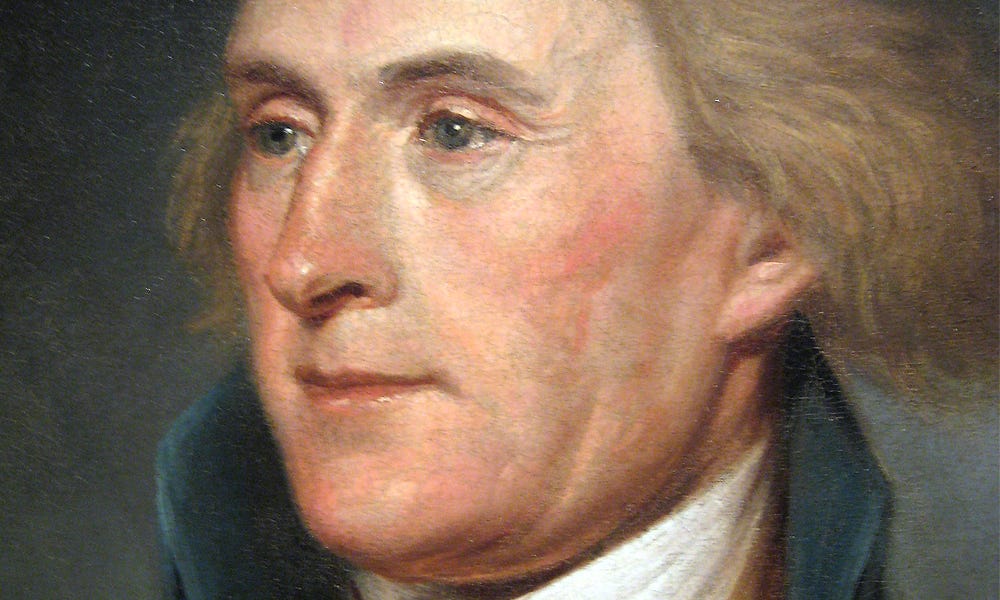
Thomas Jefferson by Charles Willson Peale, 1791.
Walk between the two storied stone lions and into the New York Public Library. Then enter the darkly lit temple directly ahead. You will see immediately one copy of the Declaration of Independence as originally drafted for submission to Congress, four pages long, each page framed, handwritten by Thomas Jefferson for a friend some days after July 4, 1776.
Jefferson wrote it almost entirely in script, which was conventional at the time. He made seven handwritten copies.
After seven words of cursive, Jefferson simulated a printer’s font on four critically important words:
A Declaration of the representatives of the UNITED STATES OF AMERICA in General Congress assembled,
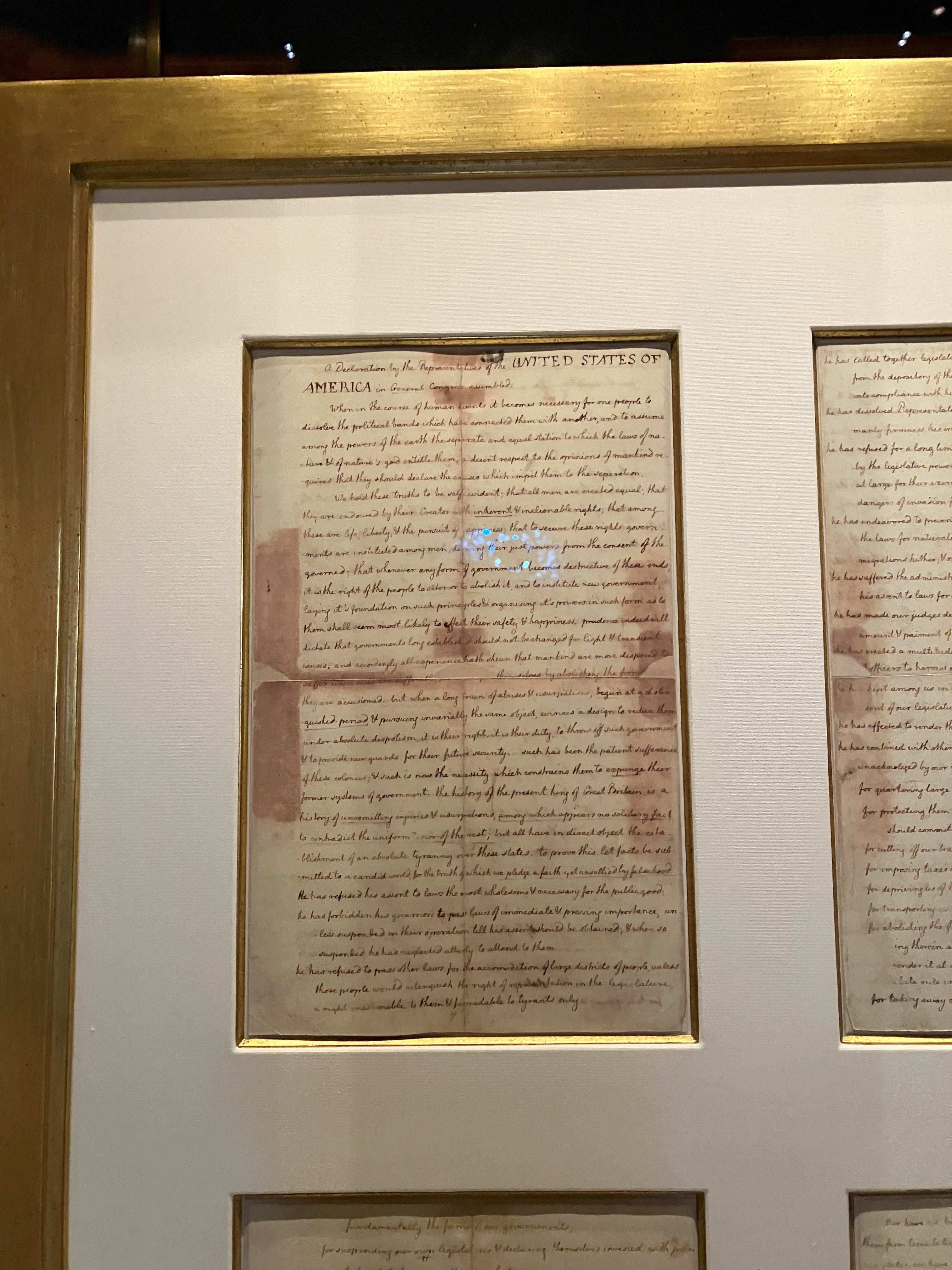
He returned to script to evoke human equality, unalienable rights, popular sovereignty, and the right to revolution; our nation’s founding principles, the most stirring segment of the document.
Why did he switch from cursive, adopt all caps, and use his pen to ornament and render in boldface the four words?
He must have wanted his friend—the friend’s name isn’t made known in the exhibit—to understand that a most important message over the four pages was the creation of a new nation. That warranted special lettering. Today, on yet another anxious July 4, it merits our own reflection.
You’ll crouch as you read down to page three, the one actual page from Jefferson’s own hand on display. (The others are facsimiles.)
There you will see one other break from cursive. It appears in one of the sections that Jefferson underlined--to mark portions eliminated by Congress from the final Declaration.
Well into his sprawling indictment of George III, Jefferson wrote:
He has waged cruel war against human nature itself, violating its most sacred rights of life and liberty in the persons of a distant people who never offended him, captivating and carrying them into slavery in another hemisphere, or to incur miserable death in their transportation thither. This piratical warfare, the opprobrium of infidel powers, is the warfare of the Christian King of Great Britain. Determined to keep open a market where MEN should be bought and sold, he has prostituted his negative for suppressing every legislative attempt to prohibit or restrain this execrable commerce.
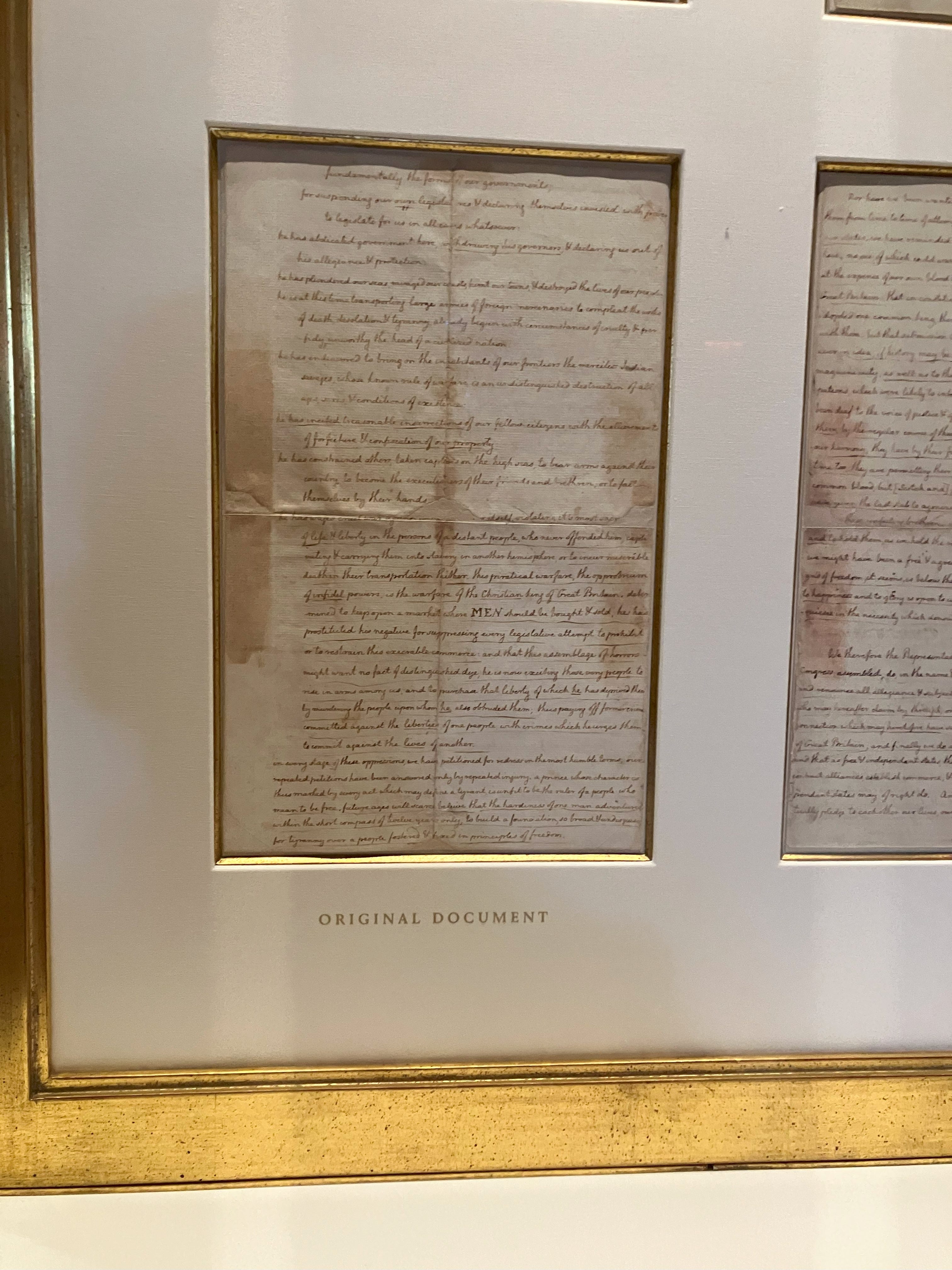
This lacerating attack on George III’s refusal to ban the Atlantic slave trade is the only other spot in this copy of the Declaration in which Jefferson uses his quill pen for special effect.
A question: Why the decision to revert to all-caps and boldface when he hit the word “MEN” in this ultimately deleted segment, an eye-catching font he deployed in only two spots in the document?
Jefferson saw the enslaved Africans as people, not livestock. His use of that all-caps MEN leaves no doubt. And that appears to have justified his revulsion at the Atlantic slave trade.
A more probing question: Jefferson believed that all MEN are created equal and thus endowed with the unalienable rights of life, liberty, and the pursuit of happiness, right? But why then did he never involve himself in any sustained campaign to end slavery—not just the Atlantic slave trade—in the United States?
Lay aside for now his unwillingness to emancipate his own slaves (except for a few members of the Hemings family.) Although that would have been the right thing to do, it would have freed only a few hundred human beings.
Jefferson would become an ever more powerful political leader, and that was where he could potentially have helped free the MEN whose suffering he laid at the feet of George III.
As President (and as leader of the Jeffersonian Republican Party) from 1801-1809, Jefferson took one important action against slavery: calling for and signing into law a ban on the Atlantic slave trade, effective on the first day that the US Constitution permitted it.
https://npg.si.edu/learn/access-programs/verbal-description-tours/thomas-jefferson-edgehill-portrait
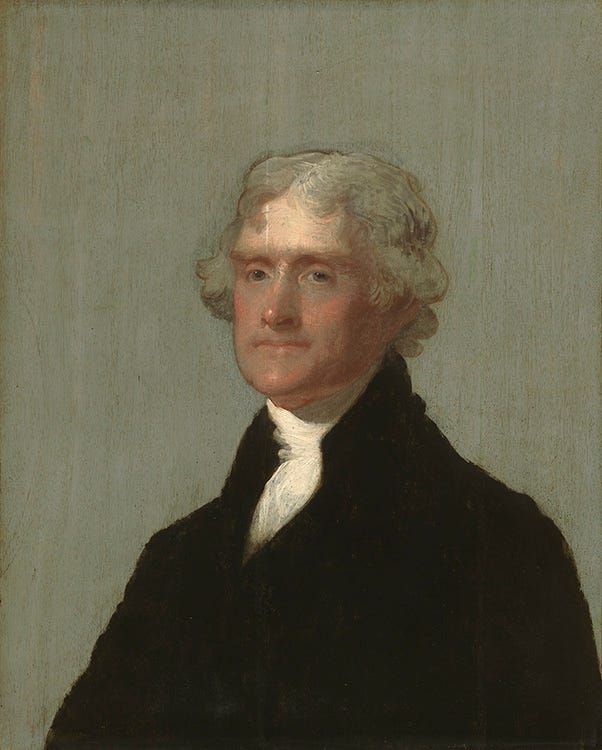
President Thomas Jefferson, by Gilbert Stuart, circa 1805.
Could he, as President, have gone farther and freed the slaves held in the various states? Probably not. The Constitution gave him no such power. (Lincoln would justify emancipation in 1863 as a military measure taken to subdue an armed rebellion. The Thirteenth Amendment ended slavery.)
But President Jefferson could have used his power in two ways.
First, he could have urged emancipation on all the slave states, using the moral authority of his office and negotiating some form of gradual emancipation undertaken by the states themselves. As the most highly respected Southern leader from 1800 to 1809, he had standing among slaveholders exceeded by none.
Second, Jefferson’s party devoted itself to expanding the nation’s boundaries and creating new states, through purchase and through invasion of native lands. Imagine the man who capitalized “MEN” explaining to party leaders, “We’ll add territories, and we’ll add new states, but we won’t add new slave states.” With Jefferson acolytes following him into office for the four terms that followed his own, this unwritten rule might have prevailed as the nation added states after the War of 1812.
Ah, but had he moved against slavery in these ways wouldn’t Jeffersonian Republicans have been punished at the polls?
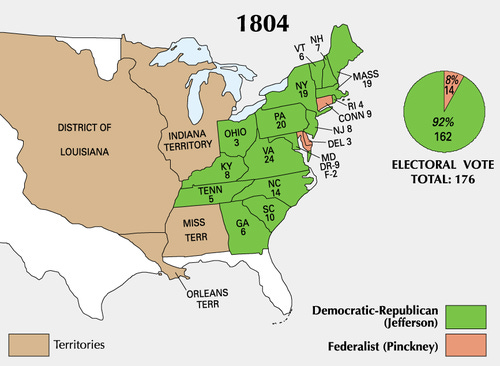
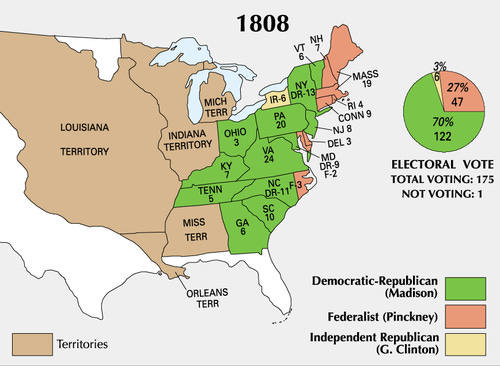
Not likely. In 1804, running against a pro-slavery Southern Federalist, Jefferson won 162 electoral votes, losing 14. In 1808, after Jefferson signed the Atlantic slave trade ban, if the white South was outraged, it didn’t show it. Jefferson’s successor, James Madison, facing the same foe, took 122, losing only 47. In the two elections, Jefferson’s party lost three electoral votes south of the Ohio and the Potomac. The political price for moral courage would have likely been small.
Jefferson wanted that friend to know that he knew that the enslaved Africans were people. At some level he must have felt good wielding that pen, bolding and capitalizing and block lettering that word. Occupying the moral high ground always satisfies.
Then why did not Jefferson the statesman, the policy maker, employ the powers inherent in party leadership and in the presidency to do no more than to ban the importation of Africans—a necessary, overdue measure, but only a start? Why did the political leader do so little to put the ongoing enslavement of native-born African Americans on the road to ultimate extinction?
What failed Jefferson?
I think that the answer may be supplied by a political colleague in Virginia. Writing to the Quaker Robert Pleasants in 1773, Patrick Henry explained that he would support abolition, were it not for the “general inconvenience” of living without his slaves. “I will not, I cannot justify it,” wrote Henry.
I imagine Jefferson might have felt the same. He loved too well the time spent at Monticello reading, writing, inventing, playing his violin, to manumit hundreds of enslaved Americans of African descent whose bondage enabled those delights. And if he wouldn’t ask this of himself, could he ask it of other slaveholders? This meant that many thousands of Black men, women, and children already in the United States would gain nothing of meaning from the author who so emphatically wrote of the MEN victimized by enslavement in America.
I don’t know about you, but people like me know all about this state of mind. We will not, we cannot justify our concessions to climate change, the exploitation of labor, or gaps in equality nationally and internationally, given the general inconvenience of living without the byproducts of each of these. Instead, we deny, we rationalize, and then we deflect by entertaining ourselves. None of these failings are as inexcusable as holding one’s fellow Americans in slavery, but they’re nothing to brag about.
In this sense, we are, many of us, modern-day Jeffersons.
Notes:
https://www.270towin.com/1804_Election/
https://www.270towin.com/1808_Election/index.html
https://teachingamericanhistory.org/document/patrick-henry-to-robert-pleasants/
Rich,
The final paragraph has comes in with some real punch. Preach on! Now of the three main items you mentioned, "climate change, the exploitation of labor, or gaps in equality nationally and internationally" I find it easiest to see how I have personally been "a Jefferson" in relation to climate change, and overall environmental care, in terms of lifestyle choices. Clearly, I know better that my choices to prioritize comfort cooling, and convenience portioned foods with excess packaging are bad for carbon output and for manageability of human generated waste materials (like plastics) - yet I persist. A lot of people are in the same boat. On exploitation of labor or equality gaps nationally and internationally, I think it is a little bit more difficult to trace obviously right or wrong lifestyle choices and to be able to detect real obvious legislative solutions that we have clearly rejected as voters - as has been the case with the environment.