
Common Sentences
Endearingly Unfinished: Memorial Day, Princeton, 1981

Early January: Snow covers most of the ground, except where people walk and scoop up after their dogs. Road surfaces wear a dispiriting light gray road-salt dust. You know you should bundle up, get outdoors, and get some fresh air. Instead, you flick on your computer and see what YouTube has to offer.
And you wind up back in time, at Palmer Stadium in Princeton, New Jersey. It’s Memorial Day, 1981, and Princeton hosts the NCAA Men’s Division 1 lacrosse championship game.
It was 45 years ago. A bygone lacrosse world. A more modest college sports media culture. Less excess in intercollegiate athletics. No transfer portal. No NIL. No DraftKings.
Upstart, undefeated North Carolina took on Johns Hopkins, who sought their fourth straight national championship and hadn’t lost in twenty-two games. Carolina represented a state with no lacrosse infrastructure. Few if any high schools played, NC State had dropped the sport, and only Carolina and Duke fielded teams of any standing. Blueblood Hopkins, of Baltimore, came from the state and city that considered lacrosse its birthright.
The gear differed, and not just the short shorts and striped socks. Everyone wore a lightweight, high-crowned, plastic helmet manufactured by the Bachrach-Rasin sporting goods company from—you guessed it—Baltimore. Even the coaches dressed differently from today’s field marshals. Hopkins’ Henry Ciccarone and Carolina’s Willie Scroggs both wore dress shirts and neckties in the humid, high 80s Jersey afternoon.
The lacrosse sticks were a lot less forgiving. The lawful pocket depth was shallower than it is for today’s wands. So most of the players used what was called a standard pocket, made up of leather thongs and nylon, to better hold the ball. A wizard like Carolina’s Mike Burnett could still score two of his goals with his back to the cage.
But many passes got dropped, so Tar Heels and Blue Jays knocked one another all over the place all afternoon pursusing ground balls. Spying Hopkins’ Walt Carswell awaiting a clearing pass, Carolina’s Pete Voelkel got a running start and launched Carswell just as the Blue Jay turned upfield. Protective rules and more forgiving stick technology have eliminated a lot of this.
No shot clock, no clock on clears, either. Coaches could substitute freely in dead ball situations. (“HORN!!!” they would holler, to stop the clock for subs. Players would shuffle on and shuffle off. It slowed the game. A lot.)
And, tellingly for Hopkins, no video replay. They had two quarter-ending goals disallowed as time expired. Then a crucial, late, Jeff Cook goal seemed to have burst though a hole in the Carolina net. Again, no goal.
If lacrosse was different 45 years ago, so was the TV coverage. ESPN’s broadcast was—how do I say this about the dark empire of 21st-century American sports?—kind of endearing. The written graphics on the screen looked composed by a Bank Street Writer. Blessedly, no chyrons.
Broadcasters Bob Smith and Leif Elsmo, a couple of lacrosse-loving Baltimoreans, added local color to the game. Baltimore folk stretch their vowels, and they don’t always enunciate. They pronounce the name of their city Balmer. When it’s not dropped altogether, the Balmer “O” is a thing of beauty. Think of someone really leaning into the o in “hoe.” Leif and Bob often called the name of “Caralahna’s Jeff Hoemahr.” (Carolina’s Jeff Homire.) Bob informed us that “Caralahna is in a zoen rahd.” (Carolina is in a zone ride.)
During time outs, Ciccarone or Scroggs materialized in a little bubble, like Glynda The Good Witch, to explain in Balmerese the answer to a question asked, answered, and taped before the game. Then they’d disappear.
Infant ESPN haltingly tried to ape Roone Arledge’s ABC-TV college football coverage, attempting what ABC cameramen dreadfully called “honey shots”: putting the camera briefly on attractive college women in the stands. One especially creepy example followed a young woman up a Palmer Stadium aisle. In another, a “coed” smiled as someone hoisted a white, red, and blue can of Budweiser a few inches in front of her face. Another caught a young woman swigging a Miller Lite.
You can’t help but feel the looseness of the time. The camera lingers on three young men, standing along the top rim of the stadium sucking beers, one shirtless, one wearing a bandana. With few cameras, ESPN often showed images of the crowd—about 22,000 people attended. I’d guess that 15,500 of them are bare-chested young men. Fans stroll along the running track that borders the field. No one shoos them away.
Hopkins had gone up 11-8 with three minutes left in the third quarter. They were the Yankees, the Fighting Irish, of college lacrosse. They couldn’t lose this.
And then they did: Carolina ran six straight goals before Hopkins finally scored to make it 14-12, Tar Heels. Then the gallant Cook slalomed all over one half of the field and part of the other to score a miraculous goal, his sixth, and to get dumped, hard.
So 14-13, Carolina, with about a minute to play.
Bob Smith soon blurts, “There are easily several thousand fans ringing the field!”
In a major crowd control failure, with the game still going on, people had come piling out of the stands and before long guys in every state of sobriety crowded close up to the field of play. The PA announcer relayed a plea from the officials that everyone move ten yards back, which seems to have worked for maybe fifteen seconds. This was the NCAA final, and it looked like a high school game played in a public park. Carolina ran out the clock and held on to win by one. Fans swarmed the field, pulled up the goals, tore apart nets.
It was all so endearingly unfinished, so human, the sport and the broadcast, as compared to the sleekness of today’s game as it’s presented on the many cable networks that broadcast D1 lacrosse.
Wistful, we who were around back then look back. Lacrosse was smaller, more modest, more fraternal. Maybe a little more insular than it should have been. But it was lots of fun, wasn’t it?
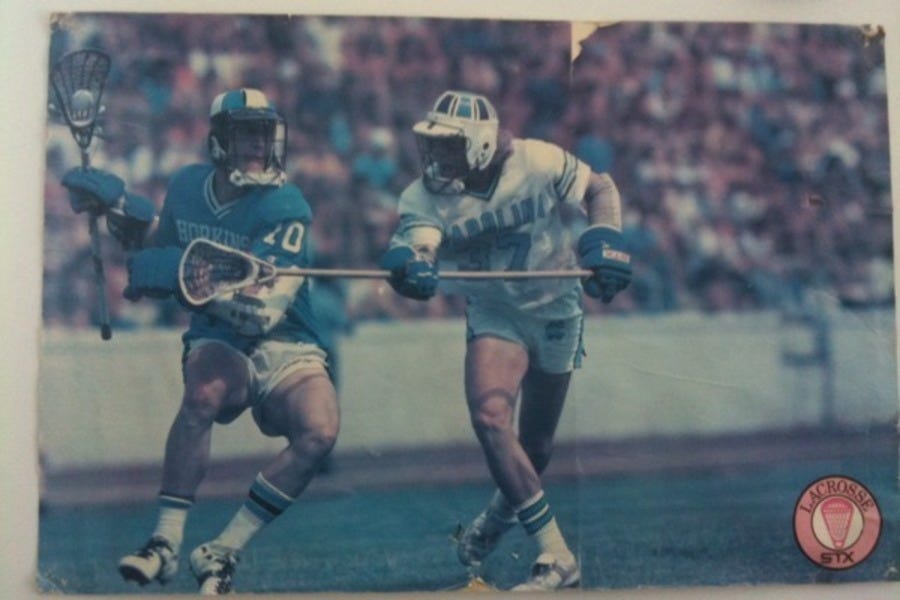
Johns’ Hopkins’ Jeff Cook (10) against UNC’s Jon Haus. Cook had six goals in a losing effort.
https://www.insidelacrosse.com/article/in-memoriam-johns-hopkins-hall-of-famer-jeff-cook/10214
Notes:
The video, of an ESPN broadcast, shorn of commercials and the halftime segment, is courtesy of Ryan Colucci, whom I don’t know. But I want to thank him for posting it.
In The American Game, his important analysis of lacrosse in American culture, SL Price argues that Carolina’s victory was an important moment in the widening of lacrosse beyond the Baltimore/Long Island/Central New York regions that had dominated the sport.
I was at that game...probably with you.